Why we built Myna
Three apps, four group chats, and a kid who'd rather watch a TikTok than answer a call. Something had to give.
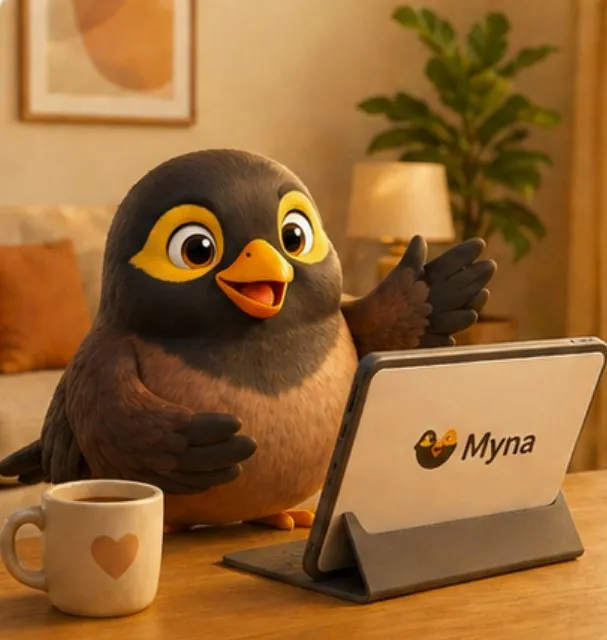
Most product stories are tidy. Founder spots problem, builds clean solution, victory lap.
Myna’s start was less tidy. It was a Tuesday evening, the kid’s tuition was getting moved by half an hour for the third time that month, my mum was the one doing pickup, my helper had run out for groceries, and the message landed in the wrong WhatsApp group.
Nobody arrived. The tuition centre auntie called me. I was in a meeting. Apologies all around.
That’s when I started writing things down.
The thing I kept hitting
I run a Singapore household. That sentence does more work than it looks. Two kids. Helper. Grandparents who help. A spouse with their own calendar. Tuition. CCA. School pickups. Doctor’s appointments. The aircon servicing guy. The fact that someone has to remember whose laundry is whose.
The tools I had:
- WhatsApp — four group chats, half of them muted, the most important messages buried under cooking photos and forwarded panic-news.
- Google Calendar — works for me, doesn’t work for my mum, definitely doesn’t work for the helper.
- Smart speaker — fine for “set a timer”, useless for “tell Charlie to brush his teeth at 9 sharp.”
- The kid’s phone — handed over reluctantly at P3 because the school CCA pickups required it. By month two, the YouTube algorithm had found him.
None of these were built for the household I actually had. They were built for individuals who happen to live near each other.
What I wanted
A house that runs itself a little.
Not a smart home. Not voice-AI-magic. Something simpler — a thing that knows the routines, knows the people, and knows when the grandparents need to be looped in but the helper doesn’t.
Something where my mum could see today’s pickups without learning a new app. Where my helper could send a voice note in Bahasa and I’d hear it in English without copy-pasting through Google Translate. Where the kid’s phone wouldn’t be a portal to TikTok.
Why Aunty
Every Singapore household has an Aunty in it somewhere. Sometimes she’s literal — your mum’s friend, the one who runs the kopitiam, the block neighbour who knows everyone’s kids by name. Sometimes she’s metaphorical — the voice in your head that says “aiyo, you didn’t bring umbrella ah?”
Aunty is the operating system of family life here. She nags without scolding, knows everyone’s schedule, switches between English and Mandarin and a bit of Hokkien depending on who she’s talking to. She’s the most underrated UX pattern in the world and nobody’s ever shipped her in software.
So we did.
Aunty in Myna isn’t a generic assistant. She’s a character. Sixteen of them, actually — Peranakan Aunty, Tiger Ah Ma, Mak Cik, Tamil Amma — pick the one that sounds like someone in your family. She narrates the chores. She announces the dinner call. She translates between you and your helper and somehow makes both sides feel respected.
When she nags Charlie to brush his teeth, it lands different than a notification.
What we’d defend if a VC told us to cut it
The helper translation feature.
Most “smart family” products skip helpers entirely — they treat the household as parents + kids and stop there. In Singapore, that’s not the household. There are 280,000 helpers in this country. They’re family-adjacent in a real, structural way, and the tools we use treat them like an afterthought. Auto-translation isn’t a nice-to-have here. It’s the difference between “ok mam” meaning okay and “ok mam” meaning “I have no idea what you just said and I don’t want to disappoint you.”
Anyone who tells us to cut that hasn’t lived in a SG flat.
Where this goes
We built Myna for the family we have. The chaotic, multi-tongued, tuition-stacked, Aunty-led one. We’re shipping it slowly, with parents and helpers and grandparents who put up with our half-finished features and tell us when something doesn’t feel right.
If that sounds like your house — come try it.
Aunty’s already inside, waiting to nag.
Myna is the family operating system for Singapore households. One hub, one app, every family member.
Try Myna